


Not with a Whimper, but a Bang.s
(T.S. Elliot … reconstituted!)
What do you do when you feel that exhausted energy at the end of a conference, event, project or even a vacation?
Last week, I attended our largest professional conference - the Academy of Management (AOM). I experienced extra planning and execution intensity this years both because of my formal Division Chair role and my informal interest to host events with the conference in my hometown of Philadelphia. At the end of the conference, I was exhausted. I just wanted to sleep.
But I knew that I needed to do something first. Because when it comes to a successful experience, extensive pre-planning and smooth execution is not enough. The big payoff comes from what you do after the event. As I learned when my sons were competitive gymnasts years ago, one of the most important parts of a routine is to “stick the landing,” to end powerfully no matter how tired you are.
Exhausted and with an injured ankle, Kerri Strug famously ‘stuck the landing’ on just one foot to help the US Women’s Team win the 1996 Olympics Gold Medal. Watch full video here.
In this newsletter, I explore how we can do a better job of “sticking the landing” after an event or conference (like AOM), following up from a networking experience, finishing off a big project… or even at the end of a family vacation. These practices don’t take a lot of time or energy. Instead, a little bit of thoughtful intentionality can take us a long way.


For those of you that are approaching the end of the (Northern Hemisphere) summer, I hope you can ‘stick the landing’ this summer!


Successful moments are not just about good planning and execution, but importantly about a powerful conclusion and follow-up.
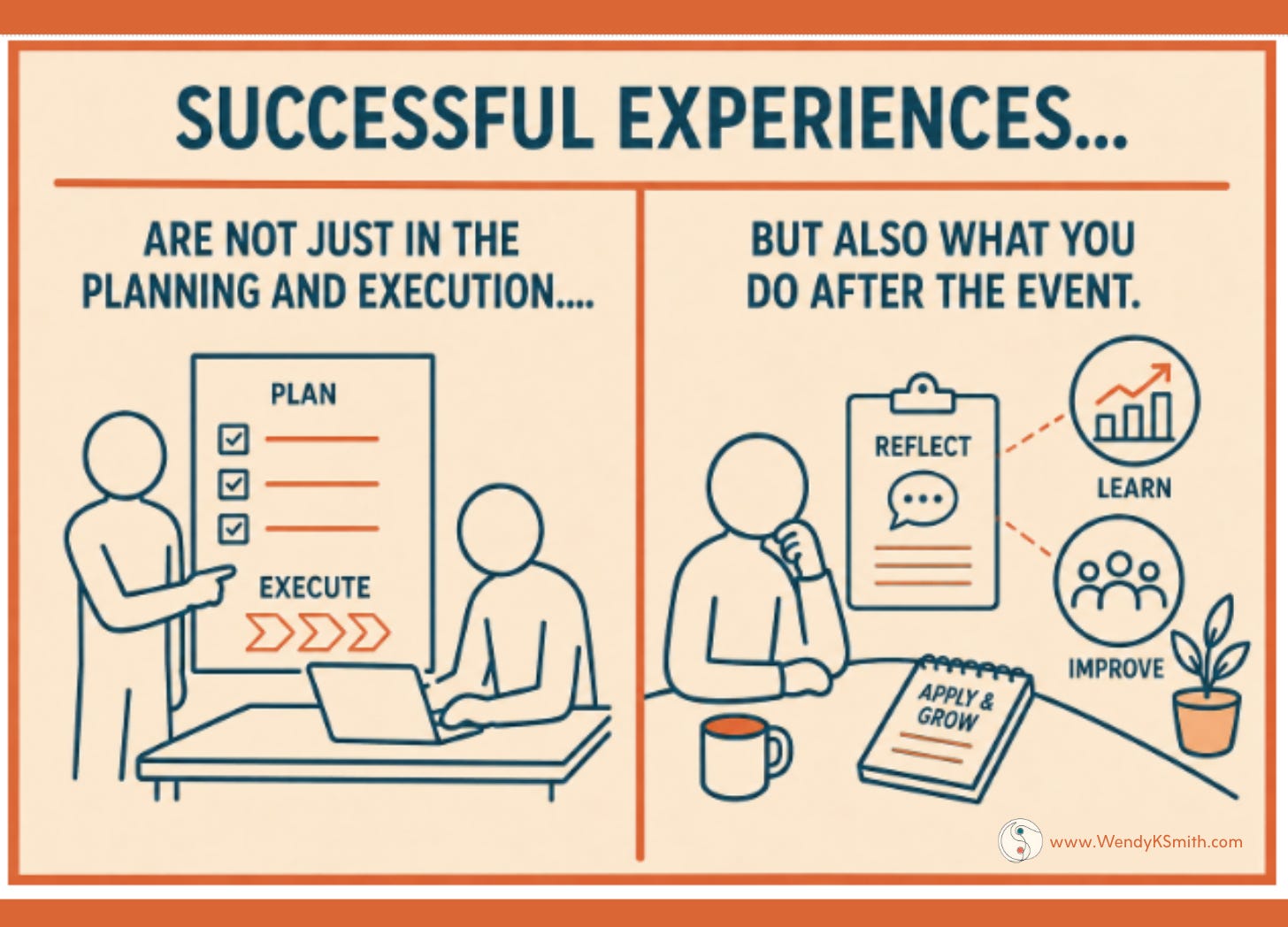

Here’s some tips to ‘stick the landing’.
End with a Bang, not with a Whimper. At the end of big events, its easy to drift off exhausted. But research shows that what we remember most from an experience is the peaks and the endings. As you plan for an event or experience, what can you do to create a exclamation point at the end of an experience so that it does not just taper off? This year at the Academy of Management, I scheduled a long walk with a good friend to end off the conference to be able to absorb all the great experiences. You can have a good a welfare at the end of a meeting, a reflection moment at the end of a class, a celebration at the end of a project.
Reflect: What’s the ah-ha? When I was an undergraduate student, a friend turned to me after a lecture and asked me, “What was your biggest insight from this lecture?” If she doesn’t ask herself that question, she told me, she will often forget everything she experienced. That question has become core to my teaching. Whether lecturing, running workshops, or giving keynotes, I frequently leave time to invite people to pause and reflect on their key insights, sharing them with one another when possible. At the end of my own projects, I take a moment to write down my lessons. When I leave big events like the Academy of Management, I pause to reflect: What did I learn? What was I proud of? What would I do again? What would I do differently? I then file those notes somewhere for easy reference to use in the future.
Close the loop with others. Years ago, a new colleague and I were talking about a book during a networking event. I decided to send her a copy of the book when we were through. That colleague and I became close friends. She still remembers the book. Research shows that small acts, like handwritten thank you notes have a much bigger impact on the recipient than we expect. Don’t skip the small moments of closure and follow-up with others.
Name and attend to the exhaustion. The practices above are all small acts that don’t require too much energy. But still, a well-executed event will often leave you tired. I make it a practice to take the time to recognize and address the exhaustion. I now build slack into my schedule to allow me to slow down, recover and if possible engage in some wellness care. This year, I got a massage soon after the Academy of Management, honoring that all the hard work was worthwhile. Build in the time after the event for wellness and recover.

Here’s some references to do a deeper dive into the research.
Kumar, A., & Epley, N. (2018). Undervaluing gratitude: Expressers misunderstand the consequences of showing appreciation. Psychological Science, 29(9), 1423–1435.
Across three experiments, people who wrote gratitude letters consistently underestimated how positive and surprised recipients would feel, and overestimated how awkward the gesture would seem.Fredrickson, B. L., & Kahneman, D. (1993). Duration neglect in retrospective evaluations of affective episodes. Journal of Personality and Social Psychology, 65(1), 45–55.
This study found that people’s memory of an experience is shaped almost entirely by its most intense moment and how it ended, largely independent of how long the experience actually lasted.
Here’s what’s coming up for me in the next few months.
August - I plan to ‘stick the landing’ to this super intense summer by spending a week with my family in Western Mass.
September - I’m excited to announce that I’ll be a visiting fellow at the Harvard Business School starting in September, and excited to head back to Boston and to HBS. Please do reach out if you are in the area. I’d be delighted to connect.
Thank you for another inspiring and appropriate post. Just what I needed to read as I prepare to give a talk. And while I’m at it … thank you for suggesting that we have a photo taken at the Preconference to the 2025 AOM in Copenhagen. It’s on my fridge and I smile every time I see it. 😄
The line about naming and attending to the exhaustion rather than just pushing to the next thing is the one I wish more senior people gave themselves permission to act on. After leaving Google, I took real time off instead of jumping straight into the next role — studied Spanish, moved countries, let the recovery actually be part of the transition rather than a delay from it. Sticking the landing at the scale of a whole career chapter is a much harder version of the same instinct.